Web UI#
pjrpc supports integrated web UI as an extra dependency. Three UI types are supported:
SwaggerUI (https://swagger.io/tools/swagger-ui/)
RapiDoc (https://mrin9.github.io/RapiDoc/)
ReDoc (https://github.com/Redocly/redoc)
Web UI extra dependency can be installed using the following code:
$ pip install pjrpc[openapi-ui-bundles]
To enable Web UI pass pjrpc.server.specs.openapi.SwaggerUI, pjrpc.server.specs.openapi.RapiDoc or
pjrpc.server.specs.openapi.ReDoc to a specification generator as a ui parameter.
Web UI will be available at /ui/ path.
It can be overridden by passing ui_path parameter to the specification generator.
json_rpc = AuthenticatedJsonRPC(
    '/api/v1',
    json_encoder=JSONEncoder,
    spec=specs.OpenAPI(
        info=specs.Info(version="1.0.0", title="User storage"),
        servers=[
            specs.Server(
                url='http://127.0.0.1:8080',
            ),
        ],
        security_schemes=dict(
            basicAuth=specs.SecurityScheme(
                type=specs.SecuritySchemeType.HTTP,
                scheme='basic',
            ),
        ),
        security=[
            dict(basicAuth=[])
        ],
        schema_extractor=extractors.pydantic.PydanticSchemaExtractor(),
        ui=specs.SwaggerUI(),
    ),
)
The following example illustrates how to configure specification generation and Swagger UI web tool with basic auth using flask web framework:
import uuid
from typing import Annotated, Any, Optional

import flask
import flask_cors
import flask_httpauth
import pydantic as pd
from werkzeug import security

import pjrpc.server.specs.extractors.pydantic
from pjrpc.server.integration import flask as integration
from pjrpc.server.specs import extractors
from pjrpc.server.specs import openapi as specs
from pjrpc.server.validators import pydantic as validators

app = flask.Flask('myapp')
flask_cors.CORS(app, resources={"/myapp/api/v1/*": {"origins": "*"}})

methods = pjrpc.server.MethodRegistry()
validator = validators.PydanticValidator()

auth = flask_httpauth.HTTPBasicAuth()
credentials = {"admin": security.generate_password_hash("admin")}


@auth.verify_password
def verify_password(username: str, password: str) -> Optional[str]:
    if username in credentials and security.check_password_hash(credentials.get(username), password):
        return username


class AuthenticatedJsonRPC(integration.JsonRPC):
    @auth.login_required
    def _rpc_handle(self, dispatcher: pjrpc.server.Dispatcher) -> flask.Response:
        return super()._rpc_handle(dispatcher)


class JSONEncoder(pjrpc.JSONEncoder):
    def default(self, o: Any) -> Any:
        if isinstance(o, pd.BaseModel):
            return o.model_dump()
        if isinstance(o, uuid.UUID):
            return str(o)

        return super().default(o)


UserName = Annotated[
    str,
    pd.Field(description="User name", examples=["John"]),
]

UserSurname = Annotated[
    str,
    pd.Field(description="User surname", examples=['Doe']),
]

UserAge = Annotated[
    int,
    pd.Field(description="User age", examples=[25]),
]

UserId = Annotated[
    uuid.UUID,
    pd.Field(description="User identifier", examples=["c47726c6-a232-45f1-944f-60b98966ff1b"]),
]


class UserIn(pd.BaseModel):
    """
    User registration data.
    """

    name: UserName
    surname: UserSurname
    age: UserAge


class UserOut(UserIn):
    """
    Registered user data.
    """

    id: UserId


class AlreadyExistsError(pjrpc.exc.JsonRpcError):
    """
    User already registered error.
    """

    code = 2001
    message = "user already exists"


class NotFoundError(pjrpc.exc.JsonRpcError):
    """
    User not found error.
    """

    code = 2002
    message = "user not found"


@specs.annotate(
    summary='Creates a user',
    tags=['users'],
    errors=[AlreadyExistsError],
)
@methods.add
@validator.validate
def add_user(user: UserIn) -> UserOut:
    """
    Creates a user.

    :param object user: user data
    :return object: registered user
    :raise AlreadyExistsError: user already exists
    """

    for existing_user in flask.current_app.users_db.values():
        if user.name == existing_user.name:
            raise AlreadyExistsError()

    user_id = uuid.uuid4().hex
    flask.current_app.users_db[user_id] = user

    return UserOut(id=user_id, **user.model_dump())


@specs.annotate(
    summary='Returns a user',
    tags=['users'],
    errors=[NotFoundError],
)
@methods.add
@validator.validate
def get_user(user_id: UserId) -> UserOut:
    """
    Returns a user.

    :param object user_id: user id
    :return object: registered user
    :raise NotFoundError: user not found
    """

    user = flask.current_app.users_db.get(user_id.hex)
    if not user:
        raise NotFoundError()

    return UserOut(id=user_id, **user.model_dump())


@specs.annotate(
    summary='Deletes a user',
    tags=['users'],
    errors=[NotFoundError],
)
@methods.add
@validator.validate
def delete_user(user_id: UserId) -> None:
    """
    Deletes a user.

    :param object user_id: user id
    :raise NotFoundError: user not found
    """

    user = flask.current_app.users_db.pop(user_id.hex, None)
    if not user:
        raise NotFoundError()


json_rpc = AuthenticatedJsonRPC(
    '/api/v1',
    json_encoder=JSONEncoder,
    spec=specs.OpenAPI(
        info=specs.Info(version="1.0.0", title="User storage"),
        servers=[
            specs.Server(
                url='http://127.0.0.1:8080',
            ),
        ],
        security_schemes=dict(
            basicAuth=specs.SecurityScheme(
                type=specs.SecuritySchemeType.HTTP,
                scheme='basic',
            ),
        ),
        security=[
            dict(basicAuth=[]),
        ],
        schema_extractor=extractors.pydantic.PydanticSchemaExtractor(),
        ui=specs.SwaggerUI(),
    ),
)
json_rpc.dispatcher.add_methods(methods)

app.users_db = {}

myapp = flask.Blueprint('myapp', __name__, url_prefix='/myapp')
json_rpc.init_app(myapp)

app.register_blueprint(myapp)

if __name__ == "__main__":
    app.run(port=8080)
Specification is available on http://localhost:8080/myapp/api/v1/openapi.json
Web UI is running on http://localhost:8080/myapp/api/v1/ui/
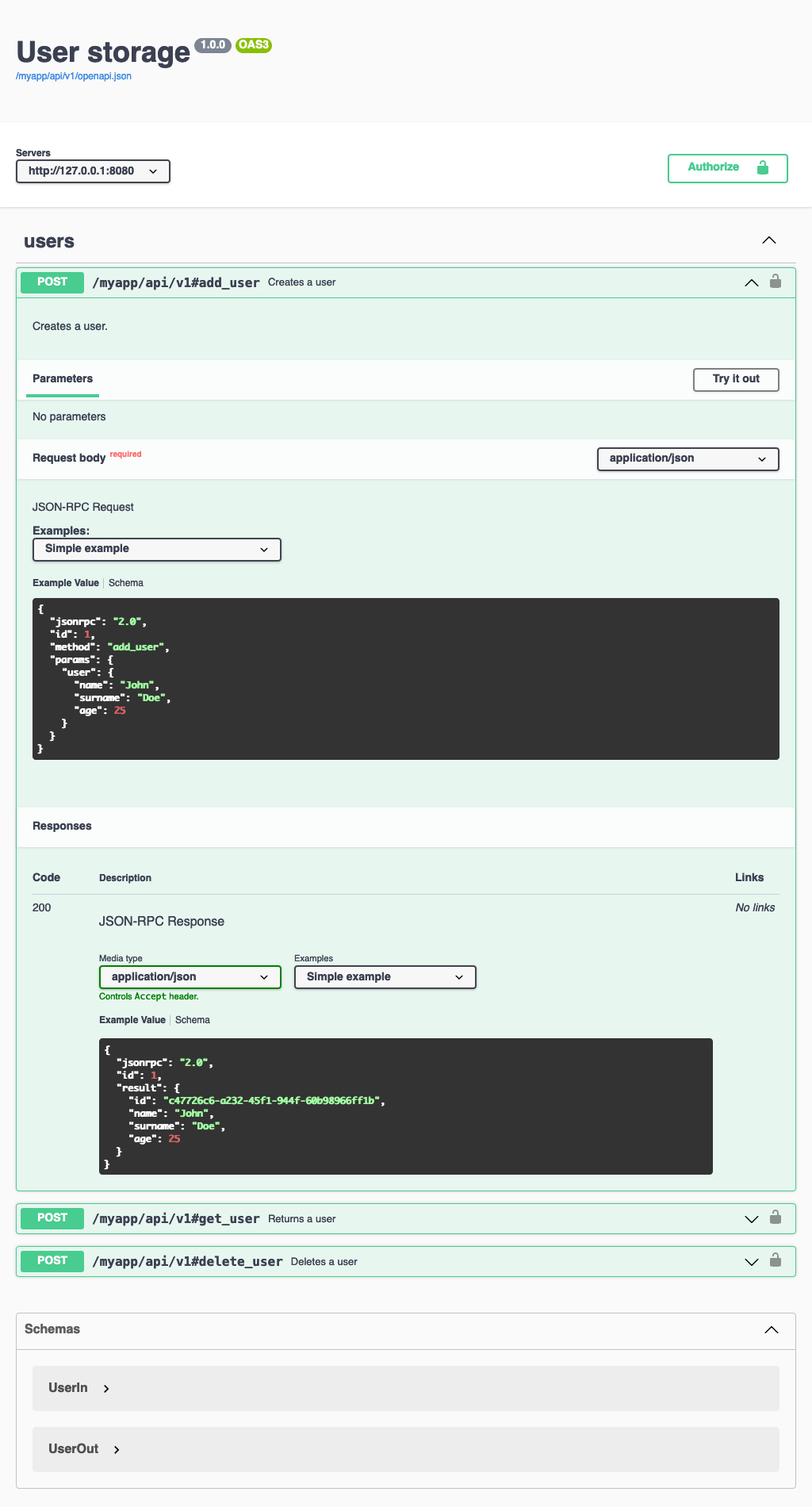
Swagger UI:#
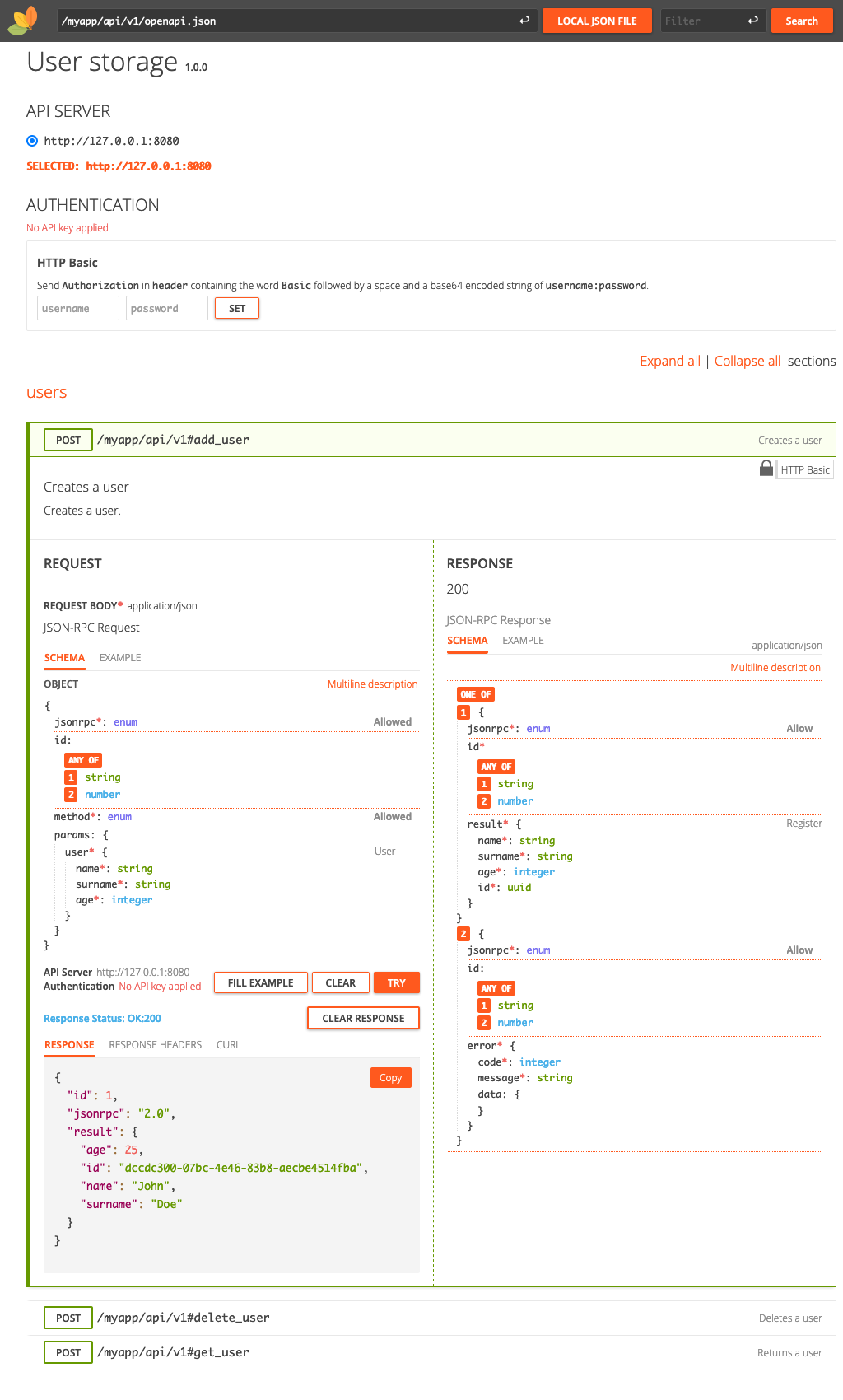
RapiDoc:#
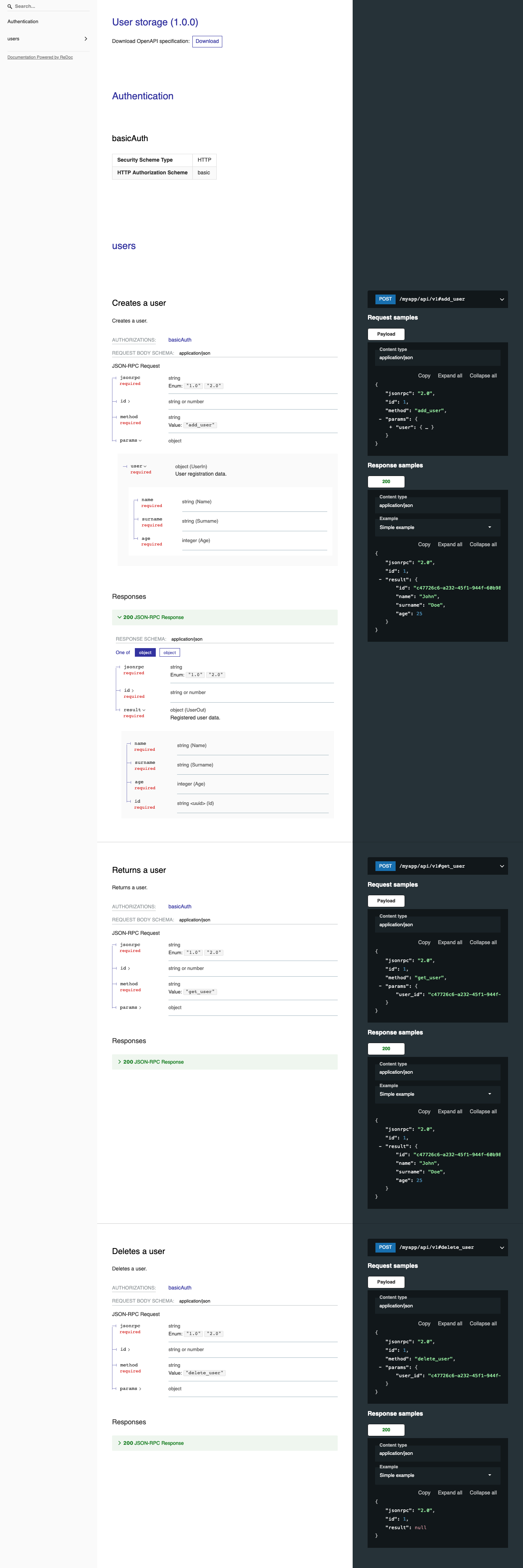
ReDoc:#